Wine teams don’t need more information. They need physical, fast, reusable tools that work in the chaos of service, not just in quiet moments behind a screen.
I’ve spent more than a decade training wine teams, and I keep seeing the same problem: we’ve digitized wine education to death. PDFs, apps, online modules — the tools are everywhere, but they’re not working. Staff still feel underprepared, customers still feel intimidated, and the gap between “what we teach” and “what actually happens at the table” keeps growing.
The problem isn’t the content. It’s the medium.
Wine itself is tactile. It’s about touch, taste, conversation and experience. Yet we’re trying to teach it through screens — the very thing pulling people away from those sensory moments in the first place. For an industry built on authenticity and human connection, that disconnect matters more than we’d like to admit.
The Digital Training Paradox
Digital wine education promised accessibility and scalability. And on paper, it delivered. A sommelier in Seattle, Wash., can access the same WSET materials as one in Sydney, Australia. A tasting room manager can assign an online module to their entire team with a few clicks.
But here’s what digital can’t deliver: retention under pressure.
Training happens in a quiet moment at a desk. Service happens in a noisy dining room with three tables waiting and a guest asking, “What’s the difference between Chablis and Chardonnay?” The server who aced the online quiz last week freezes. The knowledge didn’t stick because it was never practiced in the environment where it needed to be used.
Digital education separates learning from doing. And in wine service, that separation is fatal.
What Trade Teams Actually Need
Talk to any wine director or tasting room manager and they’ll tell you the same thing: they don’t need more information. They need tools that work in the flow of the workday.
I saw this firsthand last year while working with a Seattle-area restaurant. It had 13 wines by the glass, but not a single server could describe more than two of them. The wine reps would drop off tech sheets with the bartender — who also happened to be the wine buyer — but those sheets just sat there. When I dug deeper, the problem became clear: the servers didn’t just lack wine knowledge, they had no wine training at all. They avoided talking about wine because they didn’t know where to start. The result? Wine sales stalled, guests felt unsupported, and the restaurant left money on the table every night.
Pre-shift huddles are five minutes, not 50. Staff need to reference basics between tables, not log into a portal.
What Makes Training Stick
The best training tools I’ve seen share three qualities: they’re physical, they’re quick, and they’re reusable.
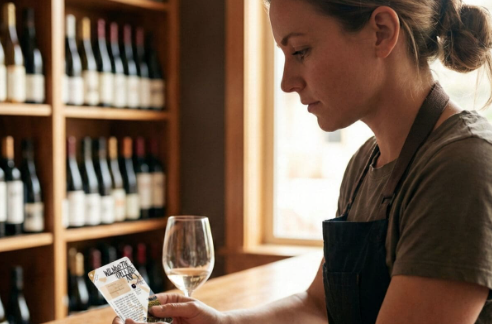
Physical tools — whether it’s flashcards, reference sheets or flavor wheels — can be picked up during downtime, shared between coworkers and left in view as a confidence boost. They don’t require a login or a charged battery. They just work.
Quick tools respect the reality of hospitality: no one has time for a 20-minute training session mid-shift. The best tools deliver value in less than two minutes. A staff member should be able to glance at a reference, internalize the key point and get back to the guest.
Reusable tools reward repetition. The more someone handles them, the more the knowledge sticks. That kind of low-stakes, high-frequency practice is how confidence gets built. You can’t replicate it with a video module that you watch once and forget.
Practical Shifts for 2026
If you’re rethinking your training program this year, here are a few shifts worth making:
Move reference materials into the space. Post tasting notes, region maps or varietal guides where your team can see them during service. Normalize glancing at a reference as a sign of professionalism, not weakness.
Shorten your training sessions. A five-minute pre-shift conversation about one region or one grape is more effective than an hour-long seminar. Make it a habit, not an event.
Make it a game. Friendly competition — whether it’s blind tasting challenges or quick trivia — turns learning into something people actually look forward to. Gamification isn’t just for apps.

Invite your team to teach each other. Peer-led training sessions, where a staff member shares something they’ve learned, build confidence and create a culture where learning is everyone’s job, not just management’s.
Choose tools that double as guest engagement. The best training tools don’t just educate staff, they also give staff something to share with customers. If a reference card or tasting note can start a conversation with a guest, it’s doing double duty.
The Bigger Picture
Wine is facing a relevance problem. Younger drinkers are choosing spirits and cocktails over wine. Hospitality workers are burned out. Guests feel more intimidated by wine than they do by any other category.
We won’t solve those problems with better PDFs.
We’ll solve them by making wine education feel alive again. By putting tools in people’s hands that work the way wine service actually works — fast, tactile, conversational and human.
The screen had its moment. It’s time to bring wine education back to the table.

Seth Cysewski
Seth Cysewski has spent more than a decade training hospitality teams and leading regional and national wine programs. He is the founder of Mistral, a Seattle-based company creating tactile wine education tools for wine professionals and enthusiasts.