It is said that when you start off in the industry⏤in farm management or a winery, in marketing or sales, retail, restaurant, as a wine scholar or “sommelier” (these days, not everyone who studies as a sommelier actually walks restaurant floors)⏤it’s good to have a mentor or two.
One burgeoning 20-something wine professional named Anna Delgado recently posted a piece entitled “Wine Education” in her Substack page, called Wineshop Punk. In it, Delgado discussed all the avenues she has been exploring in her ongoing campaign to carve out her own place in the wine industry. She’s tried practically everything.
And here, many pundits are now saying “the wine industry is dying.” Try telling that to the legions of young people going whole-hog into wine classes and certifications. More people than ever are aspiring to wine-related jobs, and putting themselves through grinders to get there. To me, that’s masochism (I hate studying and taking tests).
Delgado also mentioned the need to cultivate mentors. Older wine professionals to point them in specific directions. I was flattered that she mentioned your truly. This year, after all, I turn 70, and I’ve been working full-time in wine since I was 21 (starting as an actual restaurant sommelier). I like to think I’m still learning myself, which is necessary when you have the sieve-like brain of a senior citizen.
I do not go out of my way to mentor anyone, though, mostly because when I started in the business back in 1978 I actually avoided the idea of having a mentor like the plague. This is despite the fact that the very first two American-born Master Sommeliers were living and working in my hometown (Honolulu), in restaurants not too far from mine. I knew them, of course, but was deathly afraid of being unduly influenced by them.
Why? Because I was determined to forge my own path⏤to taste, evaluate, think, buy and sell wine in my own way, not someone else’s. True confession: To this day, I never read wine magazines. It’s not that I live with my head in the ground. It’s just my conscious way of cultivating my own voice.
I did, however, once find myself sitting next to Ronn Wiegand at a multi-winemaker panel conference; in 1981, if I recall. At the time, Ronn ran a Honolulu wine school called The Grape Escape with Ed Osterland (America’s first MS). Ronn had such a formidable mind, it came as no surprise to anyone that he would go on to become the country’s first combination MS (in 1986) and MW (1991).
I don’t remember why, but during a break Ronn mentioned what he thought was the best way to expand one’s wine knowledge⏤particularly the concept of sensory qualities associated with appellations (he probably didn’t say terroir because it would be years before that term would become a common parlance). “The way to do it,” he more or less said, “is to go to Germany… when you taste the great German Rieslings, the impact of vineyards and regions on wines becomes crystal clear.”
During the 1990s, when I was finally in a position as a multi-unit wine director to be able to do it, that was exactly what I did. I was deliberately following Wiegand, and found that he was absolutely correct. It was during visits to Germany that the entire idea of vineyard distinctions, or terroir, finally hit me.
So in a way you could say Wiegand was a “mentor.” He really wasn’t, though, because we had very few conversations over the years, but the fact that at one point he dispensed some life-changing advice makes him something of an accidental mentor.
When they spoke, I listened and took their words to heart.
The only two people I can truly say were like mentors to me were Kermit Lynch and André Tchelistcheff. Kermit, I would be able to talk to two or three times a year (my wine lists were like advertising for Kermit Lynch Wine Merchant). André, more like every few years. However, they were both like EF Huttons to me⏤when they spoke, I listened, and took their words to heart. For someone like me, who has always hated the entire idea of “influence,” the fact that their advisory over the years can be gleaned in everything I’ve done, and practically everything I’ve written, has to add up to that term: Mentorship.
In the early 2000s I met Greg La Follette (currently of Marchelle Wines), a winemaker who immediately became someone I could identify with as a professional, the same way I had with Lynch and Tchelistcheff. I was pleased to learn, during an early conversation, that one of the biggest influences on La Follette’s career was the same as mine! André Tchelistcheff.
In 2011 I conducted a formal interview with La Follette, and I asked him to go over why Tchelistcheff was so important to him. He talked about a period in his life when he was “going crazy” driving up and down the West Coast while pursuing research topics. In 1991 he came under the wing of Tchelistcheff at Beaulieu, “who became probably the single biggest influence in my winegrowing career.” According to La Follette:
André was huge⏤an amazing man, so focused on wine, holding so much knowledge in his hand, which he would sort of take out in little bits from his pocket, hold it forward for you to examine, or to pick up and put into your own pocket. He would never force anything down your throat⏤most of the time he was more interested in listening to what I had to say. André also taught me things like, “never let winemaking ruin your personal life,” and “pay attention to your children”⏤which I never forgot.
This, I guess, is probably what mentors should do: Tell you things that are useful—because they are doing as much listening as talking. Since I’m an all-American man, that’s probably one of the most impossible things for me to do.
In my very first gig as a published writer⏤writing biweekly wine columns for my hometown paper The Honolulu Advertiser, from 1981 to 2003⏤I did formal interviews of Tchelistcheff on two different occasions. In between, I was lucky enough to have had conversations with him during visits to Napa Valley and, here and there, at different wine symposiums.
A huge highlight was when I sat next to Tchelistcheff during a mid-1980s blind tasting competition where we judged 50 California Cabernet Sauvignons⏤we ended picking the exact same wine (a Beaulieu Private Reserve) as the “top” wine! This, if anything, confirmed that I might have good taste after all.
In 2016 Tasting Panel Magazine published one of my “Wandering Sommelier” columns representing an abbreviated summary of conversations I had with the great man over the years. I called it “The Timeless Tutelage of Tchelistcheff.” To this day, the lessons learned ring more significantly than just about anything I’ve heard during my career as a full-time wine professional, going on 50 years.
It also gives me a perfectly good excuse to repeat this article here, which I’ll make my last word on the subject of mentorship. Re…
The Timeless Tutelage of Tchelistcheff
The late André Tchelistcheff—Beaulieu Vineyards’ winemaker from 1938 to 1968—was a giant among men. Not physically—at about 5’3”, he made me look tall—but his deep, slightly slanted Russian eyes, nestled under thick, elvish brows, commanded military attention in every room he stood, always ramrod straight.
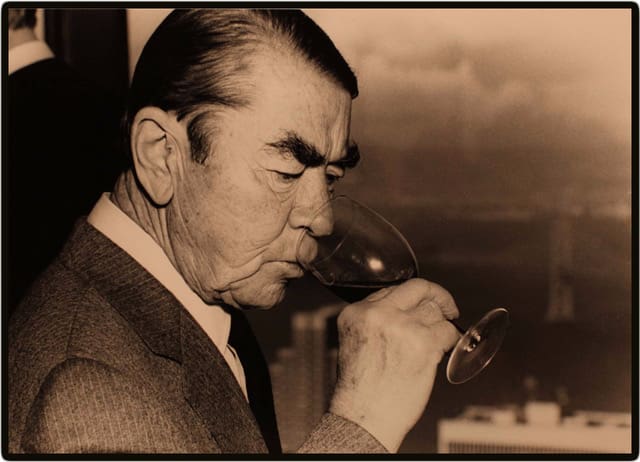 André Tchelistcheff
In 2001 I attended a trade event called Sommelier Summit, where we were treated to a symposium of other legends in the California wine industry. The panel consisted of Robert Mondavi, Justin Meyer of Silver Oak, Jamie Davies of Schramsberg, Miljenko Grgich of Grgich Hills, and Agustin Huneeus of (at the time) Franciscan and Quintessa. The vintners talked about the “Golden Age” of California wine in the 1960s. But all of their stories circled back to their collective mentor, André Tchelistcheff—the man whose rigorous, groundbreaking science and instinctive feel for terroir revolutionized California winemaking for all of them.
I first formally interviewed Tchelistcheff for a local daily newspaper in 1983, on the island of Maui, where I asked him about soil, which to most Americans—including vintners—at the time was still a fuzzy subject. Said Tchelistcheff, “I am a great defender of the importance of soil, maybe more than anybody in America. I do not accept that technology or science alone can replace natural elements… no way.
“I’d like to be specific,” added Tchelisticheff, “about Cabernet Sauvignon.” At that time there were about 4,000 acres of the grape planted in Napa Valley (today there is more than 18,000). Said Tchelistcheff, “California’s best red wine is Cabernet Sauvignon. Therefore it is planted everywhere. But within the 450 acres that we used to have in Beaulieu Vineyards, I only had 40 acres that were able to produce ‘Private Reserve.’ After over 43 years in Napa Valley, I could locate just specific sections, with specific physical and chemical constitutions of soil, that could create great Cabernet.
“For them [the French], the importance of soil is A, B, C, and more and more Californians are coming to the same conclusion. I can see that eventually we are going to have an appellation of origin system similar to France based upon soil and climate, dictating grape variety and production standards. But we are too young yet… we have to live another hundred years to reach that level.”
In retrospect, Tchelistcheff may have erred in a couple of ways. In 1981 the U.S. government had, in fact, established a system of American Viticultural Areas, and within 40 years more than 260 AVAs received official stamps of approval. The parameters for AVAs are based primarily on differentiations of soil, climate and topography.
Many pundits in wine related industries would describe that as too much progress. American appellations are being established faster than average consumers or even wine professionals can comprehend them, and attach any significance to them. Still, it’s a good thing—the sooner wines can become associated with “sense of place,” the better.
Yet I suspect that Tchelistcheff’s prognostication of a “hundred years” before a French style appellation system, regulating everything from grapes to wine production, can be instituted may never actually happen in America. Nor should it. Who’s to say what grapes should be grown in any given AVA, when they should be harvested or how wines should be made? We’re Americans. No one tells us what to do.
By the 2000s, as it were, Napa Valley became largely dominated by Cabernet Sauvignon, but that’s been happening for economic reasons—most of the land in Napa Valley is too expensive to plant anything else besides Cabernet Sauvignon—rather than governmental regulations. If anything, it’s a damned shame because Napa Valley can produce a much greater variety of interesting wines than just Cabernet Sauvignon.
In 1992 I sat down with Tchelistcheff for a second newspaper interview, and asked him about the latest viticultural advances that I had been reading about. Particularly the new technology of trellising and canopy management, resulting in claims that even greater quantities of great Napa Valley Cabernet Sauvignon can be produced, as long as the fruit to leaf ratio on vines are kept in proper balance.
Mother Nature is still in charge
Suddenly a dark cloud seemed to roll over those thick brows, as he said, “That is rubbish—you should not believe everything you read! You must not forget that when it comes to the vineyard, Mother Nature is still in charge, and Mother Nature has expressed her wish that great vineyards should grow only so much great wine, in only so many places. There is more Cabernet Sauvignon being grown in Napa Valley than ever, but there will never be more than a few of true ‘Private Reserve’ quality.”
You know what? As the years roll by and I repeatedly blind or double-blind taste Napa Valley Cabernet Sauvignons, I am still never surprised when a Beaulieu Private Reserve comes out on “top,” despite evolving winemaking styles. There are obviously a lot of great, flamboyant Cabernet Sauvignons coming out of Napa Valley today; but few as consistent at hitting that middle mark of intensity, layering and elegance as B.V.s. At least for me, Tchelistcheff has yet to be proven wrong.
Hence, my own advisory: Don’t believe everything you read, or hear. Lately, there has been talk that terroir is a “myth” or “marketing” ploy cooked up to separate the haves from have-nots. Viticulture and winemaking has improved everywhere, which has resulted in a sea of perfectly acceptable, often impressive, commercial wines, grown seemingly everywhere a grape can be grown.
All the same, our finest and most interesting wines remain those that are, not coincidentally, associated with specific appellations or vineyards. The concept of “place,” in other words, remains the same—dictated more by a proverbial Mother Nature than humankind’s vain compulsions to control every outcome of grapes. Tchelistcheff was a lot more right than wrong.
About Randy Caparoso
Randy Caparoso is a career wine professional, wine journalist and photographer living in Lodi, California. He is author of Lodi! The Definitive Guide and History of America’s Largest Winegrowing Region (2022), and Editor-at-Large/Bottom Line columnist for The SOMM Journal. Between 2010 and 2025 he composed online blogs and social media posts for the Lodi Winegrape Commission (lodiwine.com). In 2024 he was named Old Vine Hero for Communications by the UK-based Old Vine Conference. Prior to his current residency in Lodi wine country, he was the multi-award winning founding partner, vice president and corporate wine director of the Roy’s family of restaurants. He can be reached at randy@caparoso.com.